
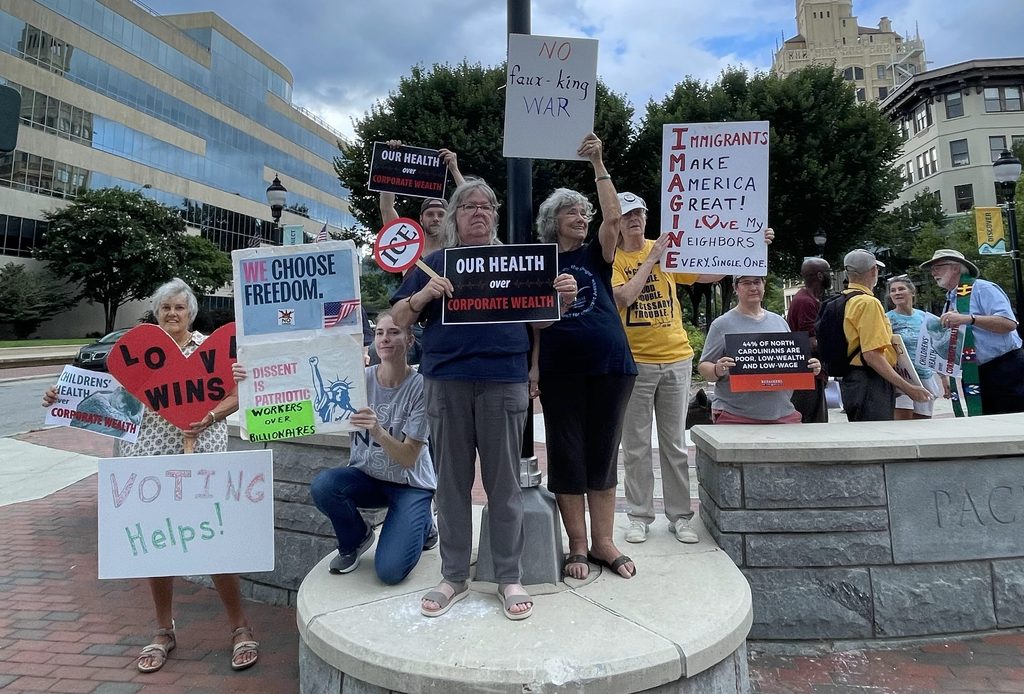
Someone commented I should comb my hair and wear nicer clothes if I want to be taken seriously when I posted this photo on social media. I removed their comment.
It seems no matter how we protest, someone complaiins about how we’re doing it.
You’ve probably heard them saying we shouldn’t inconvenience them by blocking traffic, making noise, not appearing neat and tidy enough … in other words, not inconveniencing them or reminding them things are most definitely not OK.
“Of course you’re upset, but I only have an hour for lunch and your protest is between me and my favorite restaurant.”
When we plan a big rally, it’s not enough because it doesn’t make any change; if we don’t plan a big rally/march, people are disappointed. Meanwhile those of us doing the organizing keep plugging along in ways most people don’t see, holding meetings, reaching out to speakers and musicians, getting permits, arranging for venues, making sure we have a sound system that will carry our words across as many as 10,000-12,000 people.
The big rallies are a place to learn what the issues are; smaller events offer people a chance to plug in wherever their interests lie.
It’s called organizing because we’re helping people find the work they’re good at and comfortaable doing. Some of us can stand up to power and risk arrest while others are better at raising bail money or providing food and and rides to people coming out of jail. Some of us can design and create signs while others are better at leading a march and chanting and singing.
The beautiful thing is that there’s a place for each of us in the resistance, and rather than complaining that our issues make you uncomfortable or are protests are inconvenient for you, you can join in any number of ways.
I’ve never experienced organizing at the level I’m seeing now. Groups are coming together and creating the structures we need to build an effective resistance, and Asheville is a real hot spot. I think we proved that when the G20, a group of world financial and business leaders, came to Asheville to praise our resilience as though they’s had anything to do with our recovery from Helene two years ago.
We have seen a mere fraction of what’s needed and our so-called leader has threatened to withhold any aid if his choice for US Senate loses the election. We decided to call attention to the fact that we are resilient in spite of them, not because of them.
We held banners above the highway where they traveled to get to the resort where they stayed. We held a press conference that featured people who are still waiting for help two years after the storm. We lined a main street with posters and banners telling them what we need (health care, not warfare; schools, not prisons, etc.) for three hours and we had a grieving ritual for all we lost, followed by a celebration of our own community’s helpers, a C20, allowing these organizations to set up tables with information and ways people could plug into the work of mutual aid and organizing.
I heard complaints that there should have been a rally and march, but the complaints didn’t come from any of the people who were at the table to organize the event. I suggested the complainers might want to join us in organizing the next event, but none took me up on it as far as I can see.
There is room for everyone’s talents at the table. Plug in to voting advocacy for fair elections by registering voters and helping people get to the polls or as a poll worker making sure people get to vote without being intimidated.
As someone who organized health care rallies on my own, who started her activism during the Vietnam War, and who has worked for the Poor People’s Campaign since it kicked off in 2018, I’ve seen huge growth in the last couple of years. Organizations like the Asheville Fights Back Network, WNC Votes and the Western NC Alignment Table have brought together like-minded people who are willing to work together toward nonviolent resistance.
I know not everyone can get arrested. A lot of people are afraid to come out to rallies and other events for fear of losing their jobs if they’re seen, or of being disappeared by ICE if they look like an immigrant. The climate of fear is how the enemy manages to stay in control. We need to remember, however, that we are the change we are waiting for. There are many more of us than there are of them, even though they are better armed. When they use violence and we don’t, the world sees them for who they are. It’s how the Civil Rights Movement succeeded.
So, those of us who can need to find ways to plug in and work for a better world.
I want that world for my grandchildren and great-grandchildren — and for yours.