Roadblocks to redemption

food stampsOur laws aren’t supposed to punish children for the deeds of their parents, but 32 states ban people who have been convicted of a drug felony from receiving government assistance.

Last week, Dr. Emily Wang, Assistant Professor in the Department of Medicine at the Yale School of Medicine and the Associate Director of the Transitions Clinic Network, posted a piece in The American Prospect about a 23-year-old woman named Carla who served a sentence for a drug-related crime and now can’t get food stamps for herself and her children.

Carla is out of prison, but few people want to hire an ex-convict, so she’s having a hard time finding a job. And even though she’s going back to school and staying clean, she can’t get food stamps for her children.

The ban came from the 1996 Welfare Reform Act. It was an effort to keep people from trading food stamps for drugs, even though that wasn’t a huge problem.

My question would be why the law didn’t make it a felony to trade food stamps for drugs and leave it at that.

In this country, people who have served their time are supposed to be able to rebuild their lives, but laws like this make it damn near impossible. How can you stay out of trouble when the rules keep you from providing food to your children? What parent wouldn’t get frustrated enough to commit a crime to put food on the table?

Carla, because she has been playing by the rules, has regained custody of her children, but she can’t feed them. What kind of a society sets people up for failure on that scale?

Young people who use drugs can be redeemed, and many are — as long as they’re not caught and convicted, apparently.

People like Carla deserve a second chance. Bad decisions made in one’s youth shouldn’t mean the punishment continues for their lifetime, and for the lifetimes of their children.

Efforts to change the law in Congress have died in committee, and in Georgia, which has one of the highest recidivism rates in the country, the legislature won’t even consider removing the bad.

So people are left with the choice to violate the law or watch their children go hungry.

Which would you do?

Four dead, three troopers hurt

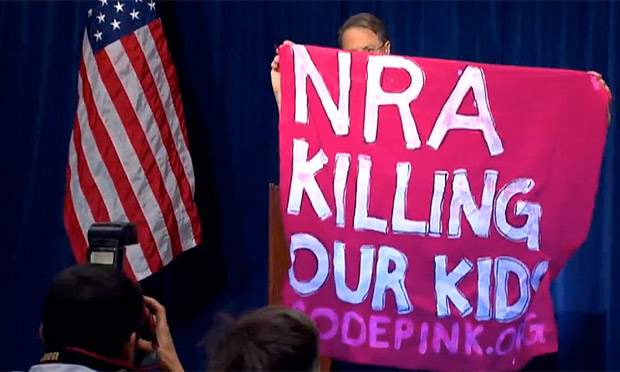
A protester at Wayne LaPierre's press conference Friday injects a little truth into the proceedings.

A protester at Wayne LaPierre’s press conference Friday injects a little truth into the proceedings.

It’s what you call irony.

National Rifle Association lobbyist Wayne LaPierre was still talking, telling us we need more, not fewer guns, that armed teachers are the solution to mass shootings in schools, as a man walked up and down a street just outside of Altoona, Pa., shooting people, killing four, according to early reports.

Among the injured are three —armed — state troopers. These are people whose job it is to stop people with guns and he shot three of them. We don’t know yet whether any of the dead are troopers.

It seems to me that something is trying to tell us that LaPierre and his ilk are full of shit. More guns is not the solution to gun violence.

Do we put guns on school buses next? Do we arm crossing guards? Remember, this latest shooting was a man walking up and down the street.

Where does the arming cease? Do we provide Sunday school teachers with an arsenal, just in case?

I’m tired of the killing, aren’t you?

I don’t think we should spend another moment listening to the NRA. I don’t even care of you’re a responsible gun owner who loves target shooting and hunting. If you believe more guns will stem the violence, you are wrong. Period.

I have tried to respect other opinions because I have a lot of friends who are responsible gun owners, but we need to control guns. We need to stand up to the bullies in the NRA and tell them where they can put their guns and ammo.

I have listened to the “other side” of the gun debate and I have reached the conclusion that they no longer deserve our time and respect. The NRA represents gun manufacturers, not gun owners. I don’t even care of we repeal the damned Second Amendment. Our gun “laws” now have nothing to do with the founders’ intentions anyway.

We have the Second Amendment because George Washington didn’t believe we needed a standing army; that well-regulated militias would suffice. It wasn’t meant for every person to have an arsenal of weapons of mass destruction. That was the totally twisted interpretation by Supreme Court Justice Antonin Scalia.

As my husband says, “Piss on your Second Amendment rights! What about the rights of innocent people to live their lives?”

It’s time to regulate guns. It’s well past time, actually.

To those who disagree that increased regulation will help stem the tide of violence, with all due respect, piss off. I’m tired of listening to it as people die by the tens of thousands in this country.


20 more names

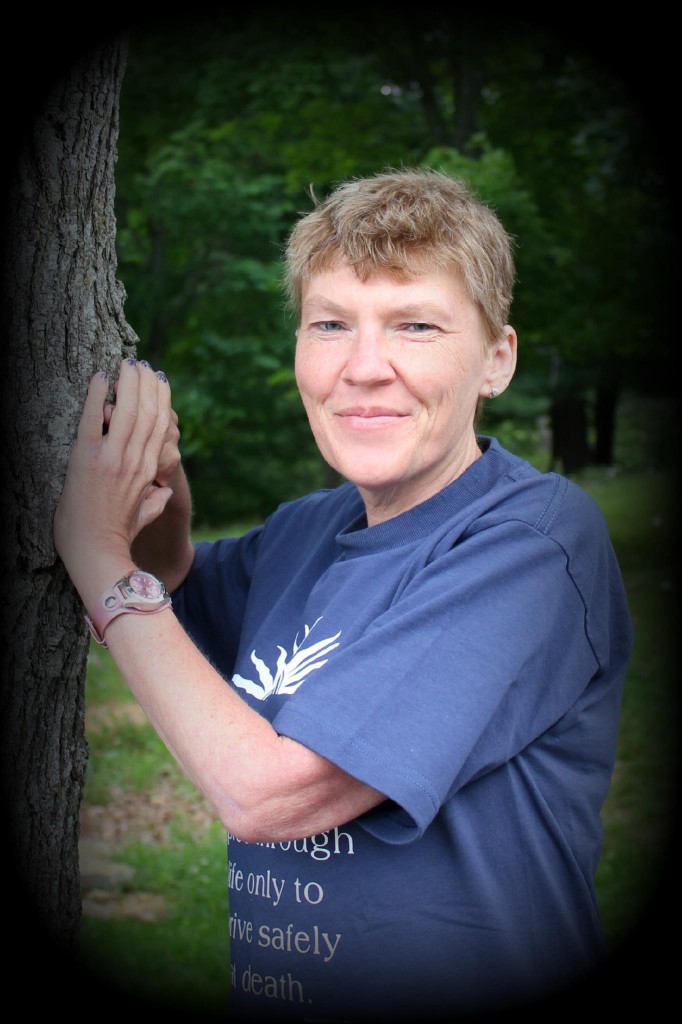
Paula, a woman who finally triumphed over addiction before she died in September. She was 42.

Paula, a woman who finally triumphed over addiction before she died in September. She was 42.

These aren’t the names of children; they are the names of people our society didn’t care enough about to save.
Some struggles with mental health issues or addiction, others lost jobs or became ill and then lost their homes.
These 20 names don’t mean much to most people. Only about 100 people attended a memorial service for them this morning.
Whatever you might think, these lives were as precious as yours or mine in the eyes of God, and except for better luck than they had, you or I might have been in their shoes. This year there were 20 names of people who were homeless who died; there were more who were not named.
On this, the shortest day of the year, people gathered in the chapel of First Baptist Church here in Asheville, as we do every year, to honor the lives lost from among our homeless.
I used to cover this service when I was a reporter and I continue to attend each year as a health care advocate and as a person who believes everyone deserves a safe place to sleep at night.
I go because four years ago, when we learned Mike was dying and raced to be with him in Raleigh, another man I never met was dying.
Tommy McMahon had gone to the emergency room the night before with a respiratory infection. He had been there before; the staff knew him. The doctors there gave him antibiotics and an inhaler and discharged him.
But Tommy knew he was too sick to go back out into the cold and wind and he refused to leave. Someone called the police and Tommy was offered the chance to go to jail for the night. He was arrested.
Sometime during the night, Tommy died, and an editor called me in Raleigh to ask who a reporter might interview for a story. As I gave the names and telephone numbers of a few people, I knew my precious son would die surrounded by love, and he did just six weeks later.
Tommy, on the other hand, died alone in a jail cell.
This season always brings Tommy to mind as much as it does a baby born in a stable and placed in a manger. I wonder if anyone loved Tommy, whether he had family and if they had given up on him. That happens a lot with homeless people — they burn through all their family members before they’re turned out onto the street. Did he have a mental illness that should have been treated? Was he addicted to drugs or alcohol and not able to get the help he needed to sober up? Did he become homeless because of an illness or a lost job?
I wonder whether anyone grieved him as I do my son and I grieve for him just in case. I pray for his soul to be at peace. I do that for each of the homeless people who die every year, but especially for Tommy McMahan because he is forever connected to my son in my heart.
Tommy’s death made me understand that we are all connected, that we are responsible for each other. I got to say goodbye to my son; Tommy’s mother didn’t. Both men died because of injustice. They died because no one who could save them cared enough to do so.
This year, as the names of the dead were read, a little about each one of them was shared — at least something about the people that someone knew and could speak about.

  • Fred Blevins, who perfected the sport-coat-over-a-bare-chest look.
  • Paula Jean Gump Chrishawn, a mother of five whose battles with mental illness and addiction caused her to lose all of them because she couldn’t care for them. She loved the color purple, and she finally won her battles. She was one week away from moving into her own apartment when she died in September.
  • Douglas Dillingham
  • Dennis Gillette, an outgoing “gentle giant.”
  • Floyd Hill, an accomplished storyteller with a deep mountain drawl and a veteran.
  • David Isles, a veteran who smiled often.
  • Herman Lee, a veteran known as “Buffalo.”
  • Andrew Marsh, called Sammy, was known for his generosity.
  • Dan Mason, who fancied himself a bodybuilder, even as he became increasingly weakened by illness.
  • Joseph Metcalf, a soft-spoken native of West Asheville.
  • Kenneth Myrick
  • Rebecca Plemmons, a mother who was just rekindling her relationship with her daughter.
  • David Pounders, a kind man who divided his time between his beloved mountains and the coast of Florida.
  • Donna Ray, a woman of kind and gently spirit.
  • Jeff Reynolds, a young man still struggling to navigate the world.
  • Delois K. Smith, a kind and gentle soul with a great sense of humor.
  • Jackie Todd Stipes, a former carnival worker who bragged that he often let the rides go longer than they were supposed to because he enjoys the looks on the children’s faces.
  • Grace Teague, who adored cats.
  • Luzella Whittemore, who was firercely independent.
  • Ivie Ward Yearns, called by his middle name, was a large man and quiet.

If you have time for a prayer today, please include these 20 souls and the people who loved them.

A pledge to reject violence. Will you join me?

Let's try to make memorials like this one obsolete.

Let’s try to make memorials like this one obsolete.

I had a great discussion with the kids in my Sunday school class this morning. We have a couple of computer geeks, a video-game aficionado or two, a kid whose dad owns several guns for hunting and kids whose parents believe there is no place for guns in a civilized society.

We started off talking about whether we should ban all guns or at least regulate them as tightly as we regulate decongestants.

We talked about whether anyone with a history of mental illness should be able to buy a gun, and we found difficulty there because whom do you refuse? I have been treated for depression, so do I get rejected? Knowing my peacenick stance, a couple of the kids laughed at the thought of me wanting to buy a gun.

“Well, you get someone’s primary care physician to write a letter,” one of the kids said.

That would be great except for the huge number of people who have no primary care physician. And it wouldn’t stop other members of their families from having guns, thereby giving access to the person who shouldn’t have it. That’s what happened in Newtown.

Armed guards at the school’s entrance wouldn’t have helped because the gunman didn’t go in the door — he crawled in through a window.

So the talk turned to our culture of violence and corruption. Gun manufacturers and the National Rifle Association have been able to shut down any talk of serious gun regulation. They’re incredibly powerful.

And violence is everywhere — in games, on the Internet, in movies and on television. It’s really difficult to escape. Parents might tell their children violence is bad, but then they sit down at the computer and play a game that’s rated M for violence. They send the kids into the theater that’s playing the G-rated movie while they go in to see the movie that’s rated R for violence. Kids see that and they internalize it.

Studies show that children who are exposed to violence in games and movies are desensitized to it.

And it’s not like kids have no access even if parents lock up the games; there are plenty of places online to play war games. It’s a recruiting tool. Gun manufacturers aren’t the only ones with a huge stake in perpetuating our culture of violence — government contractors make billions and billions off going to war, and we have been kept in a state of perpetual war for more than a decade now. Still, even as we prepare to leave Afghanistan after 12 years of war there, some call for an invasion of Iraq or Syria.

We have to reject violence as a society. It’s not just the guns, although we do need regulation.

Violence is too easy an answer when you’re surrounded by it.

When my boys were teenagers, I wouldn’t allow violent games in my house. I didn’t allow them to watch movies with an R rating for violence. If we went to the movies, I didn’t drop them off at a Disney movie and then go watch something “mature.”

I have never seen a Quentin Tarantino movie and I don’t plan to. I have never played a violent video game and I get really upset when I see my 12-year-old grandson playing one.

I don’t just preach nonviolence; I try to live it. After being pepper sprayed at a demonstration last year, the temptation to get angry and break a window was pretty strong, but instead I walked around reminding others that this was a nonviolent protest and we had taken a pledge to remain nonviolent. So we sat down and sang songs. By doing so, we made out point that violence is not the answer.

We as a society aren’t going to get rid of violence in our midst as long as we approve of it in our entertainment. We have to reject it.

I took that pledge a long, long time ago, but I think now is a good time to renew it. Will you join me? Our children’s lives depend on it.


So, when IS the appropriate time to talk about guns?

Children being ushered out of the Sandy Hook Elementary School in Newtown, Conn.

Children being ushered out of the Sandy Hook Elementary School in Newtown, Conn.

Ten days ago I posted about gun violence and now we have another tragedy, this time with a death toll of 27, 18 of them young children.

I asked on Facebook whether we might sit down now and talk about sensible regulations because this is a pro-life issue and too many people who call themselves pro-life are against regulating access to guns.

One of my FB friends said I was being inappropriate to talk about such issues so soon after this tragedy. So how long do we wait? It hasn’t even been two weeks since the last one.

The appropriate time is now, when the images of frightened children and horrified adults are still fresh in out minds. Now, when our collective national heart is broken, is the ideal time to talk about this.

The National Rifle Association, which has become an advocate for gun manufacturers and not for people, would love us to postpone this conversation, and they have lots of money to try and put up roadblocks.

The Second Amendment was not meant to give all Americans unlimited access to all the latest killing technology. It also mentioned a well-regulated militia, and that isn’t what has happened.

It is long past time to stop this madness. How can you condone this massacre of our children? What if it had been your child? What if your child is among the victims of the next massacre?

Now is the appropriate time to talk about reasonable restrictions on gun ownership. Let’s do it in memory of these 27 people and the tens of thousands of victims who came before them.

Belief and truth aren’t necessarily the same thing

During my many years as a newspaper reporter, I developed some strong standards about truth.

For one thing, the “other side” isn’t valid for every story. Sometimes the other side is nothing more than a lie.

Not long after my son died, I wrote a story about the number of people in North Carolina who were losing health insurance as they were laid off their jobs. It was pretty straightforward. Jobs were leaving the state at a record rate, and people were losing health coverage. The story was based on numbers supplied by Families USA, a national nonprofit that collects such data from every state.

The day the story ran, I got a call from the conservative “think” tank, the Heritage Foundation. The woman wanted to know if I would quote their expert in my next story about insurance. I asked for some information on her expert and she e-mailed a single quote from someone saying the free market should handle health care.

I told the woman that I doubted I would quote her expert, since the quote had nothing to back it up.

“Oh, I suppose you’re one of these people who believes people are dying left and right,” she said.

I told her I know first-hand that people are dying and unless she could back up her expert’s statement with some hard evidence, her expert was offering nothing more than an opinion.

Some people still believe the Earth is flat, I suppose, or that tobacco is perfectly safe or that mental illnesses are caused by demons. I wouldn’t quote them, either.

You can believe that the earth is just 6,000 years old, despite all the scientific evidence to the contrary, or that evolution is just a “theory,” not the truth, but I won’t support that being taught in science class, especially since there’s no science to back it up.

You can believe trickle-down economics works, but the evidence just doesn’t support it.

You can believe that cutting taxes on the wealthiest Americans is the best way to create jobs, but the evidence of the last 30 years shows otherwise.

My failure to accept your “belief” as truth is not bias against you personally. If your belief is unsound it is my job as a journalist to challenge it. I’m not here to prop up your false assumptions; my job is to get at the truth.

People didn’t ride dinosaurs. The Earth is ancient. Global warming is real. People are dying from lack of health care. Children in this country are malnourished and the food supply is unsafe. The war in Iraq was contrived and illegal. We CAN afford to pay people a living wage and give them access to quality health care. The economy won’t tank if we regulate the banksters.

The problem with journalism now is that everyone is so afraid of being called biased that they’re only too happy to print the lies and not challenge the liars. And we as a nation are left to suffer the consequences of these lies.

Bob Costas was right

Let me start by saying I don’t want to take away everyone’s guns. I’ve been target shooting and had a good time. I approve of hunting as long as the hunter uses the animal for more than a trophy.

But the United States has an appallingly high murder rate and it’s because guns are so readily available.

Someone who has had domestic violence charges against him (or her) should not have a loaded gun in the bedside table drawer. Someone who has committed a violent crime of any sort should not have access to a gun.

For someone with anger issues, a gun is just too handy, and Jovan Belcher’s actions followed the classic profile of an abuser. He snapped, killed his girlfriend and then felt so guilty he killed himself.

According to the National Coalition against Domestic Violence, there are 16,800 homicides and 2.2 million (medically treated) injuries due to intimate partner violence each year, and the cost is $37 billion.

According to the Violence Prevention Center, “an analysis of female domestic homicides (a woman murdered by a spouse, intimate acquaintance, or close relative) showed that prior domestic violence in the household made a woman 14.6 times more likely, and having one or more guns in the home made a woman 7.2 times more likely, to be the victim of such a homicide.”

In other words, if abusers didn’t have guns (and federal law prohibits anyone with an order of protection filed against them because of domestic violence to have a gun), the murder rate among women would go down dramatically.

I’m really, really tired of hearing that guns don’t kill people; people do. People with ready access to guns kill some 10,000 people in this country every year. The only countries that rank higher in gun deaths are South Africa, Colombia and Thailand. Even Mexico ranks below us.

The United States leads the world in gun ownership, with 88.8 guns per 100 people, and 34 percent of Americans owning guns. That includes collectors, many of whom own antique guns that no longer work. But it also includes people who think they need an arsenal of guns to battle the United Nations’ black helicopters.

In terms of gun homicide rate (per 100,000 population), only eight nations — Colombia, Guatemala, Paraguay, Zimbabwe, Mexico, Costa Rica, Belarus and Barbados — beat the United States, which registers 2.97 homicide gun deaths per 100,000 people.

Most other developed nations run just a fraction of our per capita gun death rate:
Switzerland (0.56), Canada (0.54), Germany (0.47), Finland (0.43), Ireland (0.32), Denmark (0.26), England (0.12), Australia, Japan, Korea? way, way below us, and Singapore at 0.02 and Hong Kong at 0.01 barely even register.

We need to have a conversation. This is not about Obama coming to take your guns, it’s about making guns a little less available to people who use them to kill other people. It’s not about whether Bob Costas was out of line when he talked about the Jovan Belcher murder-suicide, it’s about starting a serious conversation.

We don’t need assault weapons. We don’t need guns that shoot a hundred shots a minute. We don’t need guns in every home.

Bob Costas was talking truth when he quoted Fox News columnist Jason Whitlock. And since Costas often offers up commentary during football halftime, his words were not inappropriate.

The National Rifle Association has turned the conversation from responsible gun ownership and reasonable regulation to advocacy for a free-for-all that’s just short of anarchy.

It’s time to steer the conversation back to a reasonable course. Remember, the Second Amendment talks about “a well regulated militia,” not about every home having an unregulated cache of assault weapons.


Government-supported retail

On Black Friday, people turned out to protest the working conditions at Walmarts across the country.

For people who don’t want any government interference, the family that owns Walmart certainly relies pretty heavily on the feds.

About 80 percent of the people who work for Walmart are eligible for food stamps. All told, these hard-working people get $1 billion in government assistance, and the Walton family walks away with billions in profits.

Walmart employees make an average of $8.81 an hour, according to IBISWorld, an independent market research group. In most parts of the country, living wage is almost double that. A living wage is what it takes to pay rent on modest living space, buy groceries, own a car and pay utilities. There is no cable TV calculated into living wage, no meals out, no evenings at the movies, no smart phone with unlimited data.

This wage adds up to annual pay of $15,576, based upon Walmart’s full-time status of 34 hours per week. That wage, if you’re a single parent with three kids, is well below the federal poverty level of about $22,000 for a family of four.

Walmart employs 1 percent of the US population, but its payroll doesn’t come close to 1 percent of total wages paid in the country.

According to a paper by the Center for Labor Research and Education at University of California Berkeley, if Walmart started paying a $12 per hour, its workers who now make less than $9 per hour could each earn $3,250 to $6,500 more per year before taxes. If Walmart were to pass this cost directly to shoppers, the average consumer would need to pay only 46 cents more per shopping trip, or $12.50 per year.

Last week, Walmart announced that it would stop offering health insurance to new employees who work less than 30 hours per week. And you can bet most new employees will work less than 30 hours per week.

The company cited the costs of the Affordable Care Act, even though the law isn’t fully implemented for another year.

It’s just another excuse to screw the workers and keep them in poverty.

Walmart can afford to pay a better wage and more benefits. Compare it to Costco, where the average employee earns about $17 an hour and has health coverage. No, the CEO won’t be able to make more than 1,200 times what the average employee makes. Big deal.

A living wage would allow people the dignity of making their own decisions about their spending instead of having to rely on the government agencies that subsidize their food, rent and health care costs.

Walmart typically goes into markets and undercuts the prices of local merchants, driving many of them out of business. It keeps wages low, and with few other options for retail jobs in many communities, its employees have to stay on.

Sure the prices at Walmart are low — they’re subsidized by all of us taxpayers.


Be thankful and stay home with family and friends

The Boyd kids and their kids, 1977.

Today is a day to reflect on the things we have.

I like to look to my late son for the perfect example. Both he and my sister, Ellen, who died six years ago, lived in the spirit of gratitude. They both embraced life, even as it was ebbing away.

“Every day above ground is a good day,” Ellen said often during the last weeks of her life.

Mike just said, “I love my life,” even as it was confined to a single room.

Our tradition here is to go around the Thanksgiving table and talk about the things we have to be thankful for: family, friends, a warm, safe place to call home, enough food, and of course, our Star Trek DVD/Blu-ray collection.

On Mike’s final Thanksgiving, he was thankful for my bread stuffing and chocolate cream pie, and the ability to take a nap after dinner. I was thankful for him; I still am.

I’m thankful for my surviving son and his wife and kids. Even though Danny and I have had our difficulties, he is a most precious gift to me.

I’m thankful for my sister’s son and daughter, who now torment and tease me, as I do them. I adore them both, and their children.

I like to spend this day and this weekend reflecting on these things, and thinking about people who have less than I do as I crochet hats and scarves to donate to them.

I never, ever shop on Black Friday.

I don’t need to shop local on Saturday because I do that all year long, and I ignore Cyber Monday.

Our holiday warmth has been co-opted by huge, greedy corporations, and we are led to believe that buying things we don’t need will make us happy.

It won’t.

My Thanksgiving traditions include watching “King Kong,” listening to Arlo Guthrie’s “Alice’s Restaurant” and being with people I love.

This year, it’s just me and Rob and our friend, Dee, for dinner. We’ll eat, enjoy a glass of wine and maybe even light a fire in the backyard fireplace (or as Dee puts it, “burn stuff in the back yard.”).

Instead of focusing on battling other folks to save a few bucks on things you don’t need, how about focusing on family? Our time here is so short, our lives so fragile and uncertain.

As I listen for the echos of voices now silenced, I am even more grateful for the ones still here. I choose to spend time with them instead of shopping.


I decide when to shop — and where

The day after Thanksgiving is Black Friday, and we’re supposed to go without sleep so we can get big bargains. Some of the big-box stores are opening at 8 p.m. Thanksgiving night to give people the jump on the bargains.

So, with all these bargains offered to us, I think it’s important to remember that the stores and the manufacturers are still making a profit.

Now it seems we’re supposed to support small businesses the day after Black Friday and shop on the Internet on Monday.

I will do my best to not spend any money on any of those three days.

And when I do shop, it will be at local businesses.

Asheville has a wealth of artists and craftspeople, and most of them offer affordable gifts.

This area also has an incredible array of restaurants where owners aren’t planning to lay off employees or cut their hours to avoid paying anything for their workers’ health care.

The bosses at these businesses don’t get multi-million dollar bonuses. They usually make a modest income, and they feel a sense of loyalty to the people who work for them.

Papa John’s, Olive Garden, Red Lobster, Applebee’s and IHOP will lay off employees or cut their hours to avoid paying for health insurance. But Laurey’s Catering here in Asheville pays its employees a living wage AND offers health insurance. And the food is much better than at any corporate chain.

Up to 80 percent of WalMart’s employees qualify for food stamps. Spend your money there and it lines the pockets of the Walton family. Spend your money in the River Arts District and it stays here.

Buy a hand-turned wooden bowl from Mike Robinson at Third Eye Woodworking and it will help pay the rent on his home or it will buy groceries for his family. Buy a small sculpture from Greg Vineyard and he’ll spend it on things he needs here in town. In either case, you’ll have something beautiful and unique.

If someone is telling you when and where to spend your money, it’s because they want a piece of it.

I think for myself. I choose when and where to shop. You can too.

Let’s dedicate this next year to buying local whenever possible. The big corporations need us more than we need them.